CSE237A –
Final Project Report
Donghwan Jeon

Performance Comparison using
different routing metrics in Ad-hoc Wireless Networks
Abstract: We
implemented test beds platform for wireless ad-hoc networks using Click software
router and DSDV algorithm, and measured delay and throughput for different
routing metrics: minimum hop and ETX. The result shows that wireless link
quality varies a lot due to transmission power and channel dynamics, and well
designed routing metric can improve the network performance.
1. Introduction
 Wireless communication is one of the hottest research areas. Among many
challenging problems in wireless
communications, routing protocol is critical for the efficiency and lifetime of
the network. For the last decade, many proactive and reactive routing protocols [1,
2, 3] have been proposed, and some
research groups have presented the comparison of proposed routing protocols [4,
5]. However, most research was performed on only simulator rather than real
platform. While network simulations have advantages in terms of convenience,
they often ignore or simplify the complexity of wireless environment such as
asymmetric links or dynamic link condition. For this reason, some research
groups conducted research regarding wireless network with test beds, and
proposed new routing metrics such as ETX [8] and ETT [9].
Wireless communication is one of the hottest research areas. Among many
challenging problems in wireless
communications, routing protocol is critical for the efficiency and lifetime of
the network. For the last decade, many proactive and reactive routing protocols [1,
2, 3] have been proposed, and some
research groups have presented the comparison of proposed routing protocols [4,
5]. However, most research was performed on only simulator rather than real
platform. While network simulations have advantages in terms of convenience,
they often ignore or simplify the complexity of wireless environment such as
asymmetric links or dynamic link condition. For this reason, some research
groups conducted research regarding wireless network with test beds, and
proposed new routing metrics such as ETX [8] and ETT [9].
 In this project, we conducted experiments on test beds to
examine the characteristics of wireless communication link and the effect of
newly proposed routing metrics. For the test bed implementations, we ported the
Click modular router [6] to the XScale based hardware
platforms with Linux. We also carefully designed an ad-hoc network with
different transmission power levels to model more general wireless networks
with limited number of test beds. The results show important characteristics of
the wireless link and the benefits of carefully designed routing metrics.
In this project, we conducted experiments on test beds to
examine the characteristics of wireless communication link and the effect of
newly proposed routing metrics. For the test bed implementations, we ported the
Click modular router [6] to the XScale based hardware
platforms with Linux. We also carefully designed an ad-hoc network with
different transmission power levels to model more general wireless networks
with limited number of test beds. The results show important characteristics of
the wireless link and the benefits of carefully designed routing metrics.
2. Click Router
Click is a modular software router developed
by Parallel and Distributed Operating System group of MIT. The main advantages
are its modular structure and standard configuration language implementation.
Packets are processed and routed according to a given configuration modeled with
flow graph. Although Click was developed for wired network routing, MIT GRID
project expanded it to wireless ad-hoc networks with DSDV and DSR
implementations. However, we found that only DSDV implementation works with the
current version of the Click. Fig.1 shows the operation of the Click router on
kernel level and user level. We chose user level implementation due to its
convenience in debugging and portability.
2.1 DSDV
DSDV (Destination Sequenced Distance Vector
Routing) [1] is a table based algorithm based on the classical Distributed
Bellman-Ford (DBF) routing. Each node in the network maintains a routing table
for all the possible destinations with the number of hops, next hop, and a
sequence number. The sequence number plays an important role in differentiating
old routes from fresh ones and avoiding the formation of loops in routing.
Routing information is propagated by periodic broadcasting. There are two kinds
of propagations: incremental dump and full dump. Incremental dump spread only
changed information, while full dump carries all the information the node has.
DSDV always uses routing entry with the highest sequence number when it needs
to decide a route. If there are a few entries with the same sequence number, it
will use the entry with the minimum hops. We used a DSDV implementation
developed from GRID project that supports a few different routing metrics
including hop counts and ETX.
3 Results
3.1 Execution of the Project
1. Bring-up the platform with wireless network
Rebuild the Linux kernel to support PCMCIA wireless network interface card.
2. Setup a small ad-hoc network with few platforms
Setup an ad-hoc wireless network of 5 Xscale platforms so that they can communicate among each other.

3. Research the state of the art in routing
frameworks for Linux
There are many ways in which we can implement and test different routing protocols under Linux. For example, we can port each algorithm directly in the kernel or use modular framework like Click Modular Router (Click). Looking into the simplicity of porting routing protocols and the current state of art we decided to use Click.
4. Research which routing protocols to use for
our project
We decided to use DSDV routing protocol as it was the only open source real implementation available for Click.
5. Port DSDV routing protocol on test beds
6. Experiment
The experiment consisted of running some scenarios on the test beds using different routing metrics (like Hop count [HC] and ETX).
7. Analyze
We analyzed the above experiments for performance and delay and reported the results.
3.2 Experimental Setup
For the project we were able to setup a real (though small) wireless ad-hoc network using the PXA27X Xscale development platforms provided by Intel. We used 5 platforms and 5 Cisco Aironet 350 wireless PCMCIA cards. The experimental setup and the corresponding graph are shown in figure 2. We ported click modular router with DSDV routing protocol in each of this platforms. The experiments consists of performance analysis of different routing metric (HC and ETX) in the DSDV routing protocol.
3.3 Throughput Analysis
|
Source
-> Sink |
Hop
Count |
ETX |
||
|
|
Time
to send 3906 KB (sec) |
Throughput
(KB/sec) |
Time
to send 3906 KB (sec) |
Throughput
(KB/sec) |
|
1
-> 2 |
39.69 |
98.4127 |
39.76 |
98.23944 |
|
1
-> 3 |
48.63 |
80.32079 |
49.19 |
79.40638 |
|
1
-> 4 |
56.52 |
69.10828 |
54.20 |
72.06642 |
|
1
-> 5 |
54.39 |
71.81467 |
44.87 |
87.05148 |
|
2
-> 1 |
40.22 |
97.11586 |
39.83 |
98.06678 |
|
2
-> 3 |
48.81 |
80.02459 |
49.45 |
78.98888 |
|
2
-> 4 |
58.53 |
66.73501 |
47.35 |
82.49208 |
|
2
-> 5 |
52.12 |
74.94244 |
39.46 |
98.98632 |
|
3
-> 1 |
39.36 |
99.2378 |
39.13 |
99.82111 |
|
3
-> 2 |
43.13 |
90.56341 |
47.12 |
82.89474 |
|
3
-> 4 |
84.17 |
46.40608 |
52.67 |
74.15986 |
|
3
-> 5 |
52.78 |
74.00531 |
42.56 |
91.77632 |
|
Table
1: Throughput Results |
||||
To measure throughput, we use the Linux ‘wget’ and ‘time’ utility. HTTP servers were started in the nodes 1, 2 and 3 and then we measured the time needed to get a fixed amount of bytes over the ad-hoc wireless network. The results are summarized in table 1 and figure 3. In our experiments we had a setup of at most 2 hops, so in most cases the throughput of HC and ETX are similar. One result that deviated from what we assumed was that of the weakest link (3 -> 4). Theoretically, we believed that the difference in throughput between HC and ETX for 3 -> 4 will be significant compared to other links. But this was not the case, upon analysis we realized that even though node 3 cannot reach node 4 in 1 hop, while sending a stream of data, the interference in the link 2->3 also increases (since wireless communication is inherently broadcast and usually interference range is much more than transmission range (more than twice)). We assume that if we increase the number of hops between two nodes the advantages of ETX over HC will be significant.
3.4 Delay Analysis
For delay analysis we ‘ping’ different nodes (one at a time) and measure the round trip average delay between the nodes. The results are summarized in table 2 and figure 4. From the figures we can also deduce the link quality of our experimental wireless ad-hoc network. In particular if we see the figure 4d (from node 4), we can observe that there is significantly more delay between the node 1, 2 and 3 than 5.
3.5 Asymmetric Link Analysis
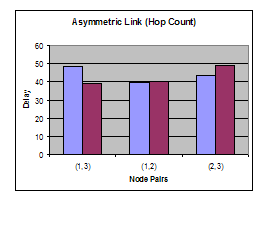
We also studied the asymmetric behavior of wireless link. For example as in figure 5 we can see that the delay from node 3 to 1 is about 20% more than that of from 1 to 3. This is primarily because the transmission power of node 3 is much less than that of 1.


|
From |
1 |
2 |
3 |
4 |
5 |
|||||
|
HC |
ETX |
HC |
ETX |
HC |
ETX |
HC |
ETX |
HC |
ETX |
|
|
1 |
NA |
NA |
3.4 3.8 5.1 |
3.5 3.9 5.9 |
3.4 3.8 8.1 |
3.6 4.3 9.0 |
11.5 55.0 122.5 |
8.3 24.3 86.4 |
5.6 7.3 12.3 |
5.6 5.8 41.9 |
|
2 |
3.5 3.9 6.3 |
3.6 4.4 11.2 |
NA |
NA |
3.5 4.5 7.5 |
3.7 4.9 11.8 |
23.6 66.7 132.7 |
4.8 20.0 81.3 |
3.5 6.2 28.2 |
3.5 5.8 35.9 |
|
3 |
3.4 4.5 8.6 |
3.4 3.9 6.6 |
23.6 66.7 132.7 |
3.4 4.8 14.8 |
NA |
NA |
9.2 58.3 177.4 |
7.8 23.6 91.0 |
5.6 17.6 63.1 |
5.6 14.0 94.6 |
|
4 |
7.1 53.6 152.1 |
7.9 29.0 62.1 |
5.8 49.6 168.6 |
4.6 15.0 45.2 |
8.5 52.1 89.5 |
7.9 19.6 74.5 |
NA |
NA |
3.4 4.1 10.8 |
3.4 4.1 11.0 |
|
5 |
5.9 7.7 20.6 |
5.7 7.8 18.9 |
3.6 4.7 13.0 |
3.6 7.6 58.5 |
5.7 8.9 27.8 |
5.7 11.5 86.2 |
3.3 5.1 39.2 |
3.5 4.1 7.7 |
NA |
NA |
|
All results are
in millisecond. In each cell the first row is for minimum delay of the
packets in that experiment. The second row is the average delay of the packets.
The third row is the maximum delay in the set of packets in that experiment. Table
2: Delay Analysis |
||||||||||

4. Conclusion:
Figure 5: Asymmetric Link Analysis
We setup test beds for ad hoc wireless
networks with Click modular router. From the various experiments, we conclude
that the quality of wireless network link varies according to transmission
power level of each wireless node and dynamic channel status. Moreover, we find
out that carefully chosen routing metrics can improve the quality of the
network in terms of delay and throughput although in our limited experimental
setup interference hinders from utilizing the improved throughput.
5. References:
[1] Charles E. Perkins and Pravin
Bhagwat. Highly dynamic
Destination-Sequenced Distance-Vector routing (DSDV) for mobile computers.
In Proceedings of the SIGCOMM ’94 Conference on
Communications Architectures, Protocols and Applications, pages 234–244.
[2] Josh Broch,
David B. Johnson, and David A. Maltz. The Dynamic Source Routing Protocol for
[3]
Charles Perkins. AdHoc On
Demand Distance Vector (AODV) routing. Internet-Draft, draft-ietf-manet-aodv-00.txt,
November 1997. Work in progress.
[4]
Josh Broth, David A. Maltz, David B. Johnson, Yih-Chun Hu and Jorjeta Jetcheva, “A performance
Comparison of Multi-hop Wireless Ad Hoc Network Routing Protocols”. Mobicom’98,
[5]
Per Johansson, Tony Larsson, Nicklas Hedman, Bartosz Mielczarek, and Mikael Degermark. Scenario-based performance analysis of routing
protocols for mobile ad-hoc networks. In Proc. ACM/IEEE MobiCom,
pages 195–206, August 1999.
[6] Eddie Kohler, Robert Morris, Benjie
Chen, John Jannotti, and M. Frans
Kaashoek. The click modular router. ACM
Transactions on Computer Systems, 18(3):263–297, August 2000.
[7]
M. Neufeld, A. Jain, and D. Grunwald, “ Nsclick:: bridging network
simulation and deployment,” in Proc. of ACM Intl Workshop on Modeling,
Analysis and Simulation of Wireless and
[8]
D. De Couto, D. Aguayo,
J. Bicket, and R. Morris. High-throughput
path metric for multi-hop wireless routing. In MOBICOM,
2003.
[9] R. Draves, J. Padhye, and B. Zill. Routing in Multi-Radio,
Multi-Hop Wireless Mesh Networks. In MobiCom,